



Beech Leaf Disease Update
Last year, we wrote about how a new disease affecting beech trees made it to our service area. Unfortunately, Beech Leaf Disease has now spread and become established in our area much faster than we expected.
Beech Leaf Disease (BLD) is caused by a nematode (microscopic worm) that lives in the leaf buds and leaf tissue. It affects both native and European beech trees. The rapid eastward spread of BLD is leading researchers to believe that the nematode is spreading on wind-dispersed aerosolized water droplets. It was truly remarkable how fast Beech Leaf Disease invaded and established itself in our area.
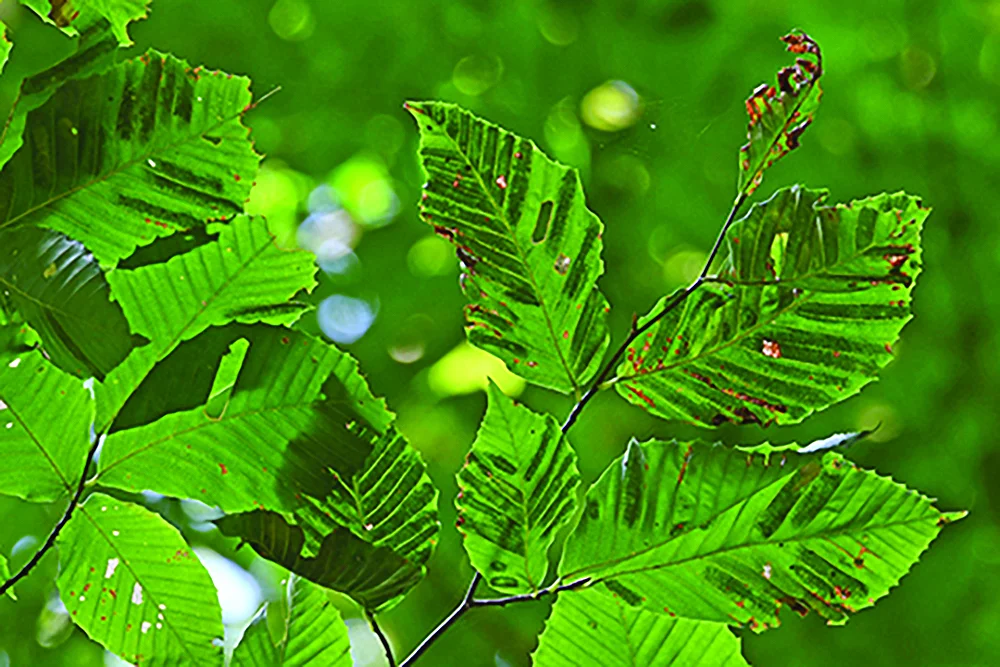
The disease-causing nematode spends the winter inside leaf buds; their activity modifies the leaf tissue, causing the distinctive leaf banding pattern that is diagnostic of BLD. As the disease progresses, leaf buds fail to open; this leads to twig and branch dieback and, eventually, tree demise. Smaller trees can succumb to BLD in two to three years; larger trees can take up to 10 years to die.
There are effective treatments available to prevent and therapeutically manage Beech Leaf Disease. Direct trunk injection of a product called Arbotect had been shown to effectively prevent and treat the disease. If a tree is suitable for canopy spraying, foliar sprays using the nematicide fluopyram are effective when timed properly. Bark treatments of Potassium Phosphite also seem to help protect trees from Beech Leaf disease.
As you can see, we have tools available to help fight BLD. Choosing the right one, or a combination, depends on your unique situation. Please contact us to have a Certified Arborist discuss options to save your valuable beech trees.
Box Tree Moth
Box Tree Moth is a destructive pest of boxwood. Native to Asia, it was detected in Europe in 2006; in Toronto in 2018; and in Erie, Pennsylvania and Kent County, Delaware in 2024. As of January 2026, federal quarantine laws restrict shipping of infested plant material in Erie County, Pennsylvania, and all
of Delaware.
Box Tree Moths produce three generations per year in our area.
They can cause extensive damage:
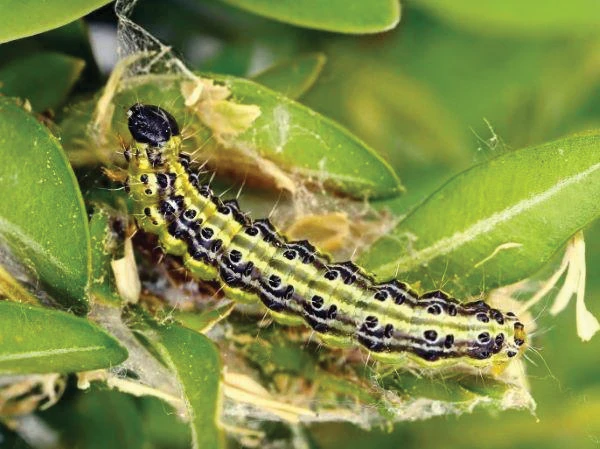
the larvae feed on the leaves and the larger caterpillars eat the entire leaf, leaving only the midrib. Left unchecked, Box Tree Moths will kill entire
boxwood plantings.
If there is any good news associated with Box Tree Moth, it is that monitoring for their presence and controlling them should be straightforward. They begin feeding on plants inside the canopies, so they can be found early by peeking in through the branches and looking for chewing or webbing. Caterpillars can be managed with biocontrols such as Bacillus thuringiensis (Bt), which is nontoxic to beneficial insects.
Early detection and treatment will be key to protecting boxwood plantings from Box Tree Moth. Please contact us for advice about the best approach for you.
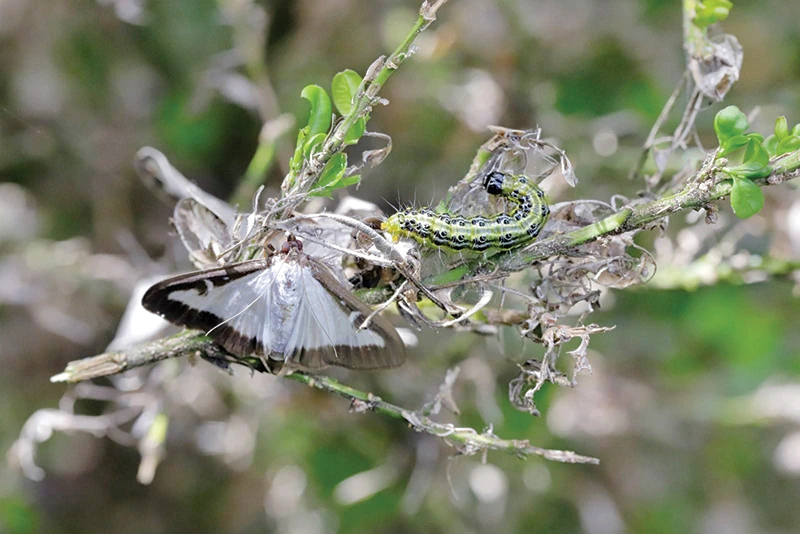
Box Tree Moth adult with caterpillar and damaged leaves